https://www.wonarm.com/the-crusades-from-the-holy-land-to-the-baltic-frontier/
Among the military orders in medieval Europe, the Teutonic Knights were famous for their strict organization, fanatical religious missions, and brutal wars of conquest. Their crusade to the East was not only a religious “holy war”, but also a military expansion that changed the political landscape of the Baltic region. From the 13th to the 15th century, the Knights established powerful regimes in today’s Poland, Lithuania, Latvia, and Estonia, leaving a profound historical impact.

The Origin and Mission of the Knights
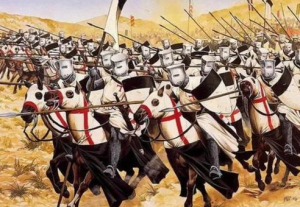
The Teutonic Knights were founded in 1190 as a medical order during the Crusades, but later transformed into a military order, modeled after the Knights Templar and the Knights Hospitaller. Their emblem is a black cross, symbolizing their mission to conquer pagans.
In 1226, Duke Conrad I of Poland invited the Teutonic Knights to help suppress the Prussian pagans in the hope of consolidating their borders. However, the Knights took advantage of this opportunity to establish their own independent state, the Order of the Knights, on the Baltic coast, and began a 200-year-long war of expansion.
Conquering Prussia: A “holy war” of blood and fire
The first target of the Teutonic Knights was the Prussians, a polytheistic Baltic tribe. Starting in 1230, the Knights launched the “Prussian Crusade”, which lasted for more than 50 years until the Prussians were completely conquered in 1283.

Livonia and Lithuania: Expansion of the Northern Crusades
After conquering Prussia, the Knights turned their attention to Livonia further east, and joined forces with the Livonian Sword Knights to continue their expansion to the northeast of the Baltic Sea.
In 1242, the Knights were defeated by Alexander Nevsky of Novgorod at the Battle of the Frozen Lake, temporarily curbing their ambitions in the Orthodox Rus’ region. However, they remained unstoppable on the northern shores of the Baltic Sea:
In the 1280s, they conquered Courland , purchased Estonian territory in 1346 , and controlled the entire eastern coast of the Baltic Sea by the end of the 14th century .
Rise and Fall: The Battle of Grunwald
The heyday of the Order was in the 14th century, when its territory covered more than 60,000 square miles and it possessed a strong economic and military force. However, excessive expansion caused dissatisfaction among neighboring countries.
On July 15, 1410, the Knights suffered a crushing defeat at the Battle of Grunwald:
Polish-Lithuanian army assembled 39,000 men
Grand Master Ulrich von Jungingen of the Knights Templar died in battle
8,000 Knights killed, 14,000 captured
This battle completely shattered the myth of the Knights’ invincibility. In 1466, they were forced to cede West Prussia to Poland in the Second Treaty of Thorn, and their national strength declined sharply.

Historical evaluation: Jihad or colonization?
The Teutonic Knights’ Crusades are often packaged as a “holy war to spread Christianity”, but in fact:
Economic motive: control of Baltic trade
Political ambition: to establish an independent state, not controlled by the Pope or Holy Roman Emperor
Cultural destruction: Prussian language and beliefs were almost extinct
The Knights’ Legacy Lives On
Prussia later became the core of the German Empire , Marienburg is the world’s largest brick castle , and the history of modern Germany, Poland, and the Baltic countries is deeply influenced by it.
The Teutonic Knights’ Eastern Expedition was one of the most enduring military conquests in medieval Europe. Their “holy war” shaped the history of the Baltic, but also left behind blood and controversy. From religious fanaticism to power struggles, their story reminds us that the “sacred mission” in history often conceals real ambitions and violence.
https://www.wonarm.com/the-crusades-from-the-holy-land-to-the-baltic-frontier/