https://www.wonarm.com/decisive-moments-in-medieval-warfare-from-1066-to-agincourt/
When discussing English history, the year 1066 is an inescapable number. In that year, darkness and glory, defeat and conquest converged in a single battle: the Battle of Hastings . It not only altered the course of succession to the English throne but also profoundly reshaped the culture, language, and political landscape of this island nation. Today, we journey back to the battlefields of 1066 to discover the events of that day.
England in 1066: The Throne Vacancy and Chaos
In 1066, King Edward the Elder of England died without leaving a clear heir. This power vacuum sparked a struggle for the throne:
Harold Godwinson
The English nobles elected Harold to the throne. He was the leader of the English themselves and had the support of the nobles and the army.
Duke William of
Normandy, France, claimed that Edward had promised him the throne and was prepared to use force to take it.
King Harald Hardrada of Norway,
The king of Northern Europe, also joined the competition, believing that he had a legitimate claim to the throne of England.
To sum up in one sentence: The struggle for the throne plunged the whole of England into an unprecedented crisis, with the three parties vying for power, and war was almost inevitable.
The Clash of Three Powers: The Prelude to the Battle
In the autumn of 1066, England faced a double threat.
With his army
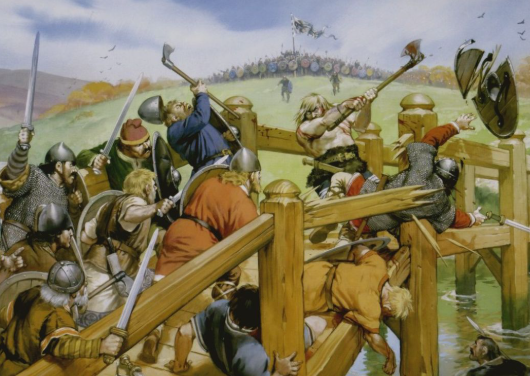
Attempting to seize the English throne from the north. Harold succeeded in defeating the Norse army at the Battle of Stamford Bridge, but the victory left his army exhausted.
The Normandy
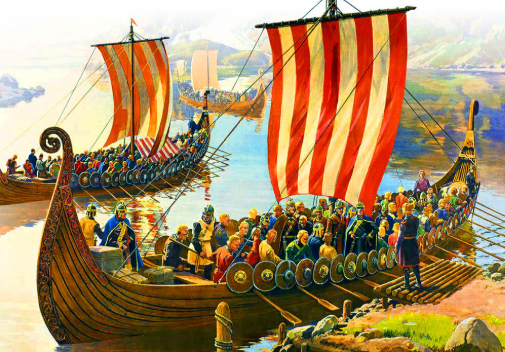
Fleet to land on the south coast of England. The English army had to retreat north immediately, rushing south from the north to fight the Norman army.
It can be imagined that Harold’s army rushed almost directly from one fierce battle to another, and their physical strength and morale were put to a great test.
The Battle of Hastings: The Day That Changed History
The Battle of Hastings officially broke out on October 14, 1066. The battlefield was located in southern England, where the Norman army and the English army faced off head-on.
Primarily
Infantry, using a phalanx defense formation and maintaining a strong defense. The Norman army, however, employed a mix of cavalry, archers, and infantry, using flexible maneuvers to gradually wear down the English defenses.
Key tactic: Feigning a retreat: The
Norman cavalry feigned a retreat, luring the English soldiers out of their formations. The broken defensive line allowed the cavalry to break through, ultimately turning the tide of the battle.
Harold’s fateful
Battle, Harold was reportedly killed by an arrow in the eye. The English army lost its command core and eventually collapsed.
To sum up in one sentence: The victory or defeat of the Battle of Hastings not only determined the ownership of the throne, but also changed the fate of the entire England.
The Price of Victory and the Beginning of Norman Rule
After the war, William became King of England (William I, also known as William the Conqueror), but victory was not easy.
The casualties on the battlefield were terrible.
The English army was almost wiped out, and the Norman army also paid a huge price in casualties.
Established his rule
By rebuilding England through the feudal system, appointing Norman nobles to control the land and gradually weakening the power of the native nobles.
Cultural and linguistic changes:
The Norman nobles brought French culture, and English gradually absorbed a large number of French words. There were obvious linguistic and cultural differences between the nobility and the common people.
It can be said that the Battle of Hastings was not only a military victory, but also a reshaping of cultural and political order.
Historical significance: Changing England’s future
The Battle of Hastings had far-reaching consequences:
Strengthening of Royal Power
The Norman Conquest brought about stronger centralization of power and a significant increase in the power of the king.
Reorganization of land and nobility
The Norman nobility replaced the native nobility of England, and the land and political structure was completely rewritten.
Cultural fusion
The fusion of French, Latin and English formed the basis of later English, while also promoting the modernization of architecture, law and administrative systems.
Military innovations
The development of cavalry and siege technology laid the foundation for England’s future war strategy.
To sum up in one sentence: Hastings was not only a battle, but also a turning point in English history. It marked the beginning of the Norman dynasty and laid the foundation for modern Britain.
Stories and interesting stories behind the battlefield
Of Harold’s arrow eye Legend
has it that Harold was killed by an arrow in the eye, an image widely circulated in history and literature.
“Battlefield Memorial” – After the Battle of Osborne Vale
A large number of corpses and weapons were left on the battlefield. The Norman army built memorials and fortifications to mark the importance of the battlefield.
The daily life of soldiers
Most of the soldiers who participated in the war were farmers, mercenaries and knights. Their lives and destinies were swept up in the torrent of history. The outcome of the battle directly determined their life and death.
History belongs not only to kings, princes, generals and ministers, but also to every ordinary soldier.
Summary : A Lesson from 1066
The Battle of Hastings in 1066 tells us that history is often rewritten in a day. The interweaving of decision-making, strategy, courage and fate ultimately determines the direction of a country.
When you look up at the castle ruins in southern England, or walk the country roads near Hastings, you are not just stepping onto a battlefield, you are touching history – that day, England was never the same again.
The Battle of Hastings reminds us that history often turns at pivotal moments, and that every conflict has the potential to alter the trajectory of nations and cultures.
https://www.wonarm.com/decisive-moments-in-medieval-warfare-from-1066-to-agincourt/